DOING Holdings
DOING Holdings
Attieke, a widely consumed staple food in Africa, has seen rising demand in recent times, especially in Ivory Coast. Many customers who want to invest in attieke production consult Jinrui Foodtech about the necessary equipment. Before making a purchase decision, you need to understand the attieke making process and the complete attieke equipment list.
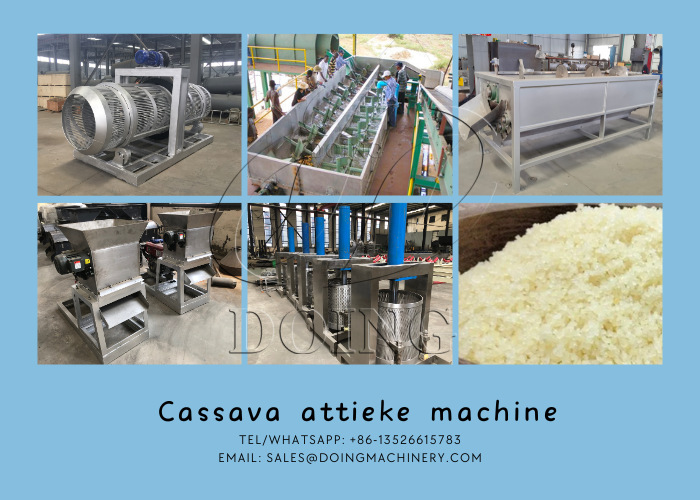 Attieke making machine
The attieke production line consists of six main stages. Below is the full attieke equipment list from Jinrui Foodtech for each step:
| Stage | Equipment | Purpose |
| Cleaning | Paddle washer (or manual) | Removes dirt and debris |
| Peeling | Cassava peeler | Removes toxic skin; peeling rate >90% |
| Grating | Cassava grater | Crushes cassava into fine mash without over-grating |
| Dewatering | Hydraulic dewatering machine | Removes excess water after fermentation |
| Granulation | Granulator | Transforms dewatered cassava cake into small granules |
| Steaming | Fully automatic steam kettle | Steams granules into final attieke product |
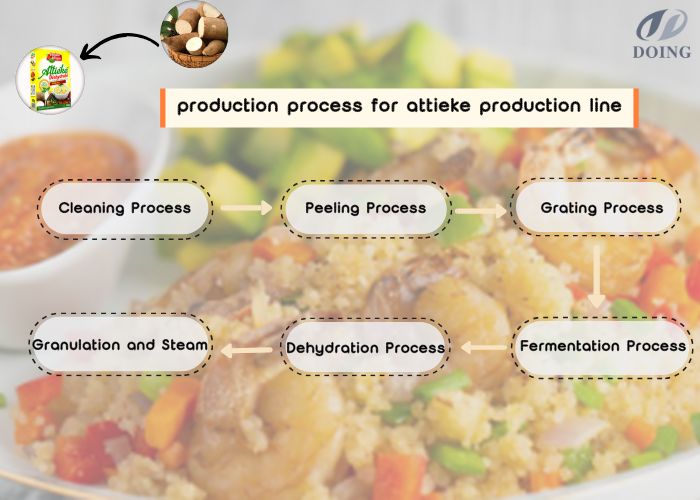 Attieke production process
Step 1 – Cleaning and Peeling
Cassava skin contains harmful substances, so it must be peeled before consumption. For small-scale attieke production, you can clean cassava manually and use a cassava peeler for efficient peeling. For larger volumes, a paddle washer is recommended.
Step 2 – Grating
The peeled cassava needs to be crushed. However, due to the special texture of attieke, it should not be grated too finely. The cassava grater for attieke is the ideal choice for this step.
Step 3 – Fermentation and Dewatering
After grating, the mash is left to ferment for about two days. Then, a hydraulic dewatering machine removes excess water. Customers prefer this equipment because of its simple operation and easy maintenance.
Step 4 – Granulation
This is a critical step in the attieke making process. A granulator transforms the dewatered cassava cake into small, uniform granules.
Step 5 – Steaming
The final step uses a fully automatic steam kettle to steam the granules into finished attieke. Jinrui has improved this equipment over many years, achieving excellent durability and low energy consumption – making it ideal for small attieke production lines.
Regarding attieke equipment list pricing, costs vary depending on scale and configuration. Please contact Jinrui Foodtech for a customized quote. To help customers set up their attieke production faster, Jinrui has established overseas warehouses in Nigeria and is planning to open a local factory for assembly and sales. We sincerely hope every customer receives the best service and machine quality.