DOING Holdings
DOING Holdings
When building a shortlist of pyrolysis equipment manufacturers, buyers typically gather supplier names from search results, trade shows, or industry referrals. Common names on that shortlist include:
Klean Industries (Canada) — tire pyrolysis and recovered carbon black
DOING ECO (China) — small to industrial scales of pyrolysis equipment for multi-feedstock recycling, with skid-mounted, batch, semi-continuous and latest fully continuous types of pyrolysis systems
PYREG (Germany) — continuous tire and industrial waste pyrolysis
Brightmark Energy (USA) — large-scale plastic pyrolysis
Beston Group (China) — batch and continuous pyrolysis systems
Huaying (China) — pyrolysis and distillation equipment
International manufacturers often serve large-scale projects in highly regulated markets, while Chinese pyrolysis equipment manufacturers compete on cost-effectiveness, delivery speed, and customization flexibility. This guide provides a structured comparison framework across six dimensions — from manufacturing qualifications and technical performance to after-sales infrastructure and total cost of ownership — so you can evaluate each pyrolysis equipment supplier on your shortlist systematically.
Reliable pyrolysis plant manufacturer DOING ECO
The first step in evaluating any pyrolysis equipment manufacturer is confirming whether you are dealing with a genuine manufacturer or an intermediary. The Chinese pyrolysis equipment market includes trading companies and small workshops that source equipment from third parties, attach their own branding, and resell at a markup.
Request the following from each pyrolysis equipment supplier and verify independently:
Business license: Confirm the registered scope includes “manufacturing”, not just “sales” or “trading.”
ISO 9001 certification: Verify the certificate number on the issuing body's website.
CE marking or export compliance certificates: Required for equipment entering EU, African, and Southeast Asian markets.
Patent certificates in the company's own name: A pyrolysis plant manufacturer with genuine R&D capability holds patents covering reactor design, gas recovery, or control systems.
Factory ownership proof: Land use certificates or property deeds confirm the manufacturer owns their production facility.
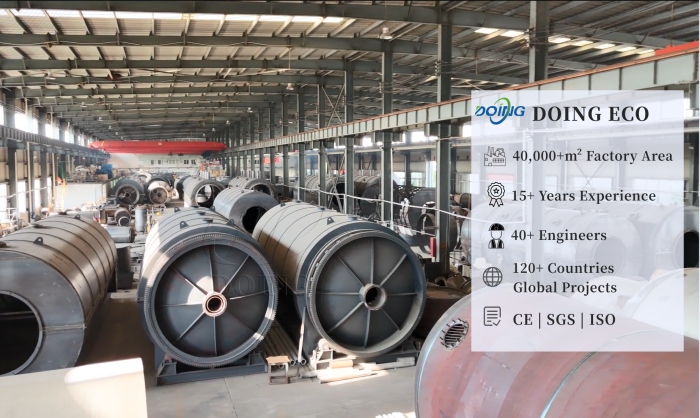
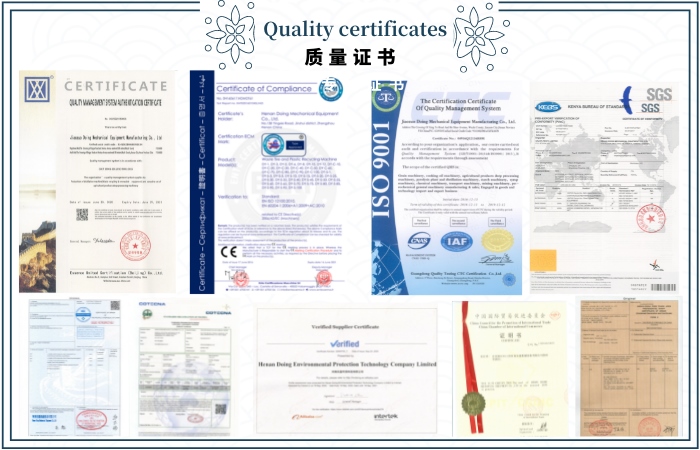
DOING ECO (Henan Doing Environmental Protection Technology Co., Ltd.) operates multiple production bases across Henan province with 200+ employees across manufacturing, engineering, and service divisions. The company holds 50+ patents and honors covering pyrolysis reactor design, gas recovery systems, and automated control integration. As a government-certified High-Tech Enterprise, DOING ECO meets R&D investment thresholds and intellectual property requirements that distinguish serious pyrolysis equipment manufacturers from resellers. They hold ISO 9001:2015 certification and CE marking for international markets.
Pyrolysis machine manufacturer DOING ECO certificates
This is the dimension that most directly determines your operating costs and product quality. Differences in reactor design, heating method, and automation level affect daily throughput, labor costs, energy costs, and output consistency across the entire equipment lifespan.
Compare actual production data, not brochure specifications. Ask each pyrolysis equipment supplier for test reports from production runs using feedstock similar to yours.
Key parameters to compare:
| Performance Parameter | What to Compare | Red Flag |
|---|---|---|
| Pyrolysis conversion rate | Actual percentage of raw material converted to products | Claims above 99% without third-party test report |
| Daily throughput | Tons processed per 24-hour continuous run | Numbers that only apply to ideal feedstock conditions |
| Energy consumption per ton | kWh required per ton of finished product | No data provided |
| Oil recovery rate | Percentage of feedstock converted to pyrolysis oil | No lab analysis report available |
| Continuous run duration | Hours before scheduled maintenance | Claims of “unlimited” runtime without maintenance intervals |
Understand the technology type. Most Chinese pyrolysis equipment manufacturers offer either batch-type or continuous-type pyrolysis systems. Batch-type furnaces process 1-10 tons per batch with 8-12 hour cycles plus cooling time, requiring 2-3 operators. Continuous-type systems — like those produced by DOING ECO; run 24 hours non-stop, processing a minimum of 20 tons daily with 1-2 operators via PLC automated control. According to DOING ECO's production data for continuous tire pyrolysis systems, conversion rates reach up to 99%.
DOING ECO equips continuous pyrolysis oil production line with a PLC intelligent control cabinet managing automated feeding, temperature regulation, gas recovery switching, and discharge through a touchscreen interface. The system captures combustible gas released during pyrolysis and channels it back into the combustion chamber, making the process thermally self-sustaining once operating temperature is reached.
When comparing pyrolysis plant manufacturers, request a factory visit or live video demonstration showing active production lines running with real feedstock.
Environmental compliance is where many pyrolysis equipment purchases fail silently after installation. The reactor may perform effectively, but if the emission treatment system is incomplete or mismatched to the furnace's gas volume and temperature profile, you face a choice between production and regulatory compliance.
When comparing waste pyrolysis equipment suppliers, ask each specifically:
Is the emission treatment system included in the base package, or sold separately? Some pyrolysis equipment manufacturers quote a low base price for the reactor alone, then charge separately for dust removal, gas purification, and exhaust treatment — components essential for legal operation.
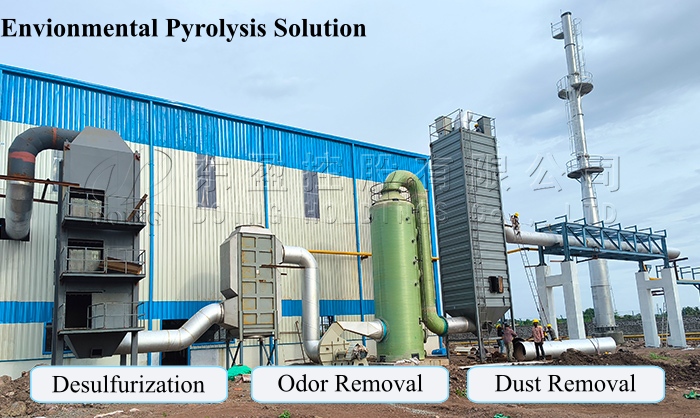
What specific emission treatment components are included? A properly integrated system should include cyclone dust removal, spray tower purification, and waste heat recovery.
Can the supplier provide emission test reports? Request data showing exhaust output measurements against the environmental standards in your target market.
DOING ECO integrates the emission treatment system as a core component of every pyrolysis line: cyclone dust removal separates coarse particulates; spray tower purification cools the gas and removes fine particulates through water scrubbing; waste heat recovery captures residual thermal energy and redirects it to pre-dry incoming raw material. This integrated approach — treating emission control as a core engineering requirement rather than an optional accessory — is a strong indicator of a mature pyrolysis equipment manufacturer.
Environmental devices of DOING ECO pyrolysis equipment
The difference between purchasing a single reactor and receiving a complete production line determines how much integration risk you absorb.
Most smaller pyrolysis equipment manufacturers operate an FOB model — they ship a standalone reactor, and you become responsible for connecting it to preprocessors, conveyors, dryers, gas recovery units, and condensation systems sourced from different vendors. Integration mismatches, incompatible control systems, and warranty disputes between equipment suppliers are common consequences.
A pyrolysis plant manufacturer offering EPC (Engineering, Procurement, Construction) turnkey delivery designs, manufactures, and commissions the entire line as a single coordinated system — from raw material preprocessing through pyrolysis to byproduct recovery. DOING ECO provides EPC turnkey delivery covering consulting, R&D design, manufacturing, installation, and full-lifecycle service. When one pyrolysis equipment supplier takes responsibility for the complete system, you receive a single point of accountability for performance guarantees, warranty claims, and production throughput targets.
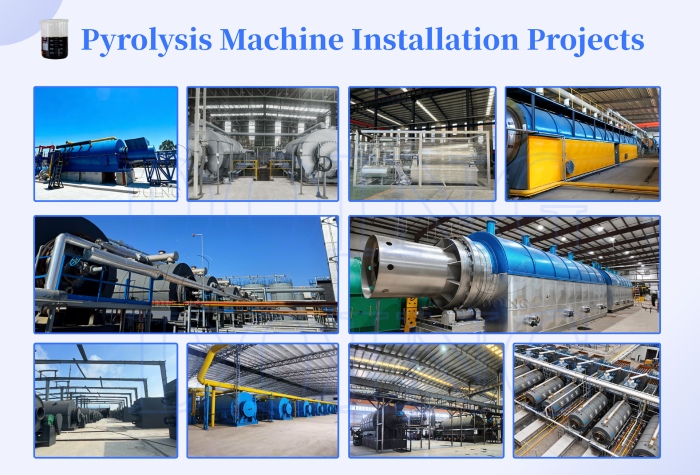
DOING ECO worldwide pyrolysis machine projects
After-sales support is the dimension where the gap between a serious pyrolysis equipment manufacturer and a typical exporter becomes most visible. The majority of Chinese pyrolysis equipment suppliers operate a pure export model: ship the machine, provide remote guidance via video call, and dispatch spare parts from China when needed — a process that takes 3-4 weeks per shipment and halts production.
When comparing pyrolysis equipment suppliers' after-sales capability, verify:
Does the manufacturer have a registered subsidiary or office in your region? A local entity provides fundamentally faster response than remote support from China.
Are overseas warehouses maintained for spare parts? Physical inventory hubs reduce lead time from weeks to days.
Does the supplier offer on-site installation and commissioning? Engineers available for overseas deployment indicate a pyrolysis plant manufacturer that stands behind their equipment.
What is the stated response time for technical issues? Request specific commitments — “within 48 hours” means something; “we provide timely support” does not.
DOING IMT ECO operates a registered subsidiary in Nigeria — Henan Doing Machinery Nig. Ltd — with on-ground staff providing West African clients with direct access to technical support and spare parts. Overseas warehouse locations enable spare parts dispatch within days rather than the 3-4 weeks typical of shipping from China. Engineers are available for overseas installation, commissioning, and maintenance as a standard offering. DOING ECO's project portfolio spans 120+ countries, demonstrating the logistical capability to support international operations at scale.
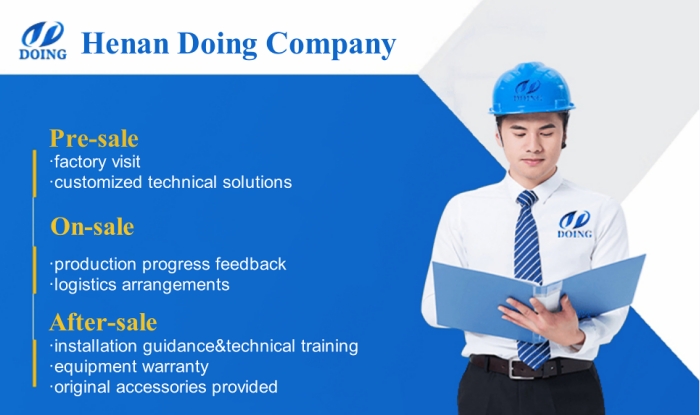
Technical services of pyrolysis equipment manufacturer DOING ECO
A frequent mistake buyers make when comparing pyrolysis equipment manufacturers is focusing on the base equipment price alone. A quotation that appears 20-30% cheaper may exclude the environmental treatment system, installation, spare parts, or operator training — making the actual project cost significantly higher.
When comparing quotations, ensure all pyrolysis equipment suppliers are quoting against the same scope:
| Cost Component | May Be Quoted Separately | Typically Included in EPC Packages |
|---|---|---|
| Base reactor/furnace | ✓ | ✓ |
| Preprocessing equipment (shredder, dryer) | Often excluded | ✓ |
| Emission treatment system | Often excluded | ✓ |
| Condensation and oil collection system | Often excluded | ✓ |
| PLC control system | Sometimes manual control quoted | ✓ |
| Installation and commissioning | Often excluded | ✓ |
| Operator training | Often excluded | ✓ |
| Spare parts package (1-2 years) | Often excluded | ✓ |
| Transportation and insurance | Varies | Varies |
The correct comparison metric is total cost of ownership (TCO) over a 5-year horizon, including base equipment cost, installation cost, annual energy consumption, annual labor cost, annual spare parts and maintenance, emission compliance retrofitting (if not included initially), and production downtime cost linked to after-sales response time.
DOING ECO provides a detailed scope breakdown in every quotation, clearly separating base equipment, optional upgrades, installation, training, spare parts, and transportation. Standard delivery time for a complete continuous pyrolysis line is 60-90 days from order confirmation, with 15-30 days for on-site installation and commissioning. Warranty covers 12 months from commissioning, with lifetime technical support and spare parts supply.
Start by confirming that all pyrolysis equipment manufacturers on your shortlist are quoting against the same feedstock, capacity, process type, equipment scope, compliance requirements, and Incoterm. Separate included, optional, and excluded items before comparing prices. Beyond price, evaluate each pyrolysis plant manufacturer's manufacturing qualifications (ISO certification, patent portfolio, factory ownership), technical references (similar feedstock + capacity + process type), and after-sales infrastructure (overseas presence, spare parts availability, installation support). A pyrolysis equipment supplier that provides a transparent, detailed quotation with verifiable references is generally a safer choice than one offering the lowest price with minimal documentation.
Several warning signs suggest you may be dealing with a trading company rather than a manufacturer: the business license scope lists only “sales” or “trading” without “manufacturing”; the company cannot provide patent certificates in its own name; factory photos show rented workshop space rather than owned facilities; the company has no ISO certification or cannot provide a verifiable certificate number; technical staff cannot answer detailed engineering questions about reactor design or process parameters; and the company cannot arrange a live factory visit or video demonstration of running equipment. DOING ECO, by contrast, welcomes factory visits and provides live demonstrations of active production lines at their Henan bases.
Request specific details: client industry and location, equipment configuration delivered, installation date, current operational status, and measurable outcomes (throughput, energy cost per ton, product quality metrics). Prioritize references with similar feedstock + capacity + process type rather than the supplier's largest project. A pyrolysis equipment manufacturer confident in their track record will provide verifiable references with contact information. DOING ECO's project portfolio spans 120+ countries, including installations processing waste tires, mixed plastics, oil sludge, and biomass — each with documented throughput data and recovery rates.
Watch for suppliers that cannot provide a specific response time commitment for technical issues, have no overseas warehouse or subsidiary in any market, cannot name a specific engineer who would handle your installation, or offer only “remote technical support via video call” as their after-sales model. DOING ECO operates a registered subsidiary in Nigeria with on-ground staff, maintains overseas warehouses for spare parts dispatch within days, and deploys engineers for on-site installation and commissioning as a standard offering — infrastructure that goes well beyond typical export-model after-sales.
Yes. Most established pyrolysis equipment manufacturers offer sample processing services where you send your waste material to their facility for testing. DOING ECO operates pilot-scale pyrolysis equipment at their Henan production base, processing your specific feedstock and providing test data including oil yield, carbon black quality, energy consumption, and emission measurements. For buyers who want to validate performance on-site before scaling, DOING ECO also offers frame-type small-unit pyrolysis equipment starting at 100 kg/day capacity — pre-assembled and shipped for simple connection and commissioning.
DOING ECO's engineering team provides free technical assessments for buyers comparing pyrolysis equipment manufacturers — including feedstock analysis, equipment configuration benchmarking, TCO projections, and factory visit coordination. With 50+ patents and honors, ISO 9001:2015 and CE certification, and pyrolysis lines operating in 120+ countries, DOING ECO meets every evaluation criterion in this guide. Share your project requirements to receive a customized comparison proposal.
Get a Customized Proposal